

Showing posts with label Italy. Show all posts
Showing posts with label Italy. Show all posts
Sunday, July 8, 2012
Gomorra by Roberto Saviano


Saturday, September 26, 2009
Train to Trieste by Domnica Radulescu
Train to Trieste book was bought by my girlfriend in this August during our visit in Budapest.
She liked very much the book so I also read it. I found it rather mediocre but not bad at all.
I give it 3 stars out of 5. I am also aware that a novel written in English about the life of a Romanian immigrant discussing also the life under the communism is a daunting task and not appealing to the general public. Stereotypes, preconceived ideas or even trivial facts (probably for the reader with any Romanian background) can be found in abundance in the book. Probably they are meant to make more understandable the Romanian milieu of the novel for the non-Romanian reader. But some are funny, strange, ludicrous, misplaced or even seem false when they are mentioned : unique word dor , the 14 Dacian words, oaie word, the italian senza la valigia is almost in Romanian for her and so one. Maybe reading with Hungarian background a book written by a Romanian mind can explain it as we humans are in a natural way subjective beings.
Train to Trieste is the first novel of Domnica Radulescu who is born in Romania and lives in US since 1983, she is a professor of women studies and of Neolatin languages at Washington and Lee university in Lexington of Virginia state. The novel is narrated in the first person by Mona the main character, she remembers harsh times from communist Romania since she was 17 years old, her love for Mihai, her immigration to Italy and US and her life in the new world.
She presents the life of communist Romania a country which was run like a police state where every day life was poisoned by informers who intruded personal life, where food shortages, lack of necessities, inhuman treatments were part of existence. In the beginning of the novel we see Mona fall in love with Mihai, her deceased girlfriend's, Mariana's lover. From start her infatuation is poisoned by suspicion: she fears that Mihai has something to do with her death also later on she suspects him to be an informer of state security. Yet she continues to love him never questioning him whether he is an informer.
In Mona's case we can see what level can take the distrust, suspicion and the love can easily turn to hatred. She does not confine with him his intent of immigration, she fears that he might inform state security regarding the activity of her parents (his father is a fervent anti-communist who takes part in a conspiracy group), in fact she perceives him as an informant.
This lack of communication and even trust towards Mihai is evident. Mihai is living in Braşov while Mona is in Bucharest where she studies and she has to make travels mostly in vacations to keep up the relationship between them. When Mihai questions their relationship pointing out that they are living in two different worlds she answers with anger, hatred, hitting and spitting calling him by names an informer.
I would say that their relationship mostly a holiday type one, I would say Mona uses him to fulfill her sexual needs and fantasies without the need to confront him with her suspicion. This lack of communication is evident. Later on when her husband Tom (whom she marries in US not out of love as she admits) tells her that they should learn to communicate she finds it preposterous. In time his marriage with Tom becomes a wreckage, she cheats him and has an affair with the Serb Jovan. The fruit of this relationship is a child. For a period it seems that the newborn will mend her marriage as Tom accepts the child as his own after the storm settles between them. But when she has a child from Tom she breaks up the marriage, yet Mona describes Tom as a man good for being a husband.
The narrative is linear from the events in Romania to the immigration to Italy with the help of the Serbian Biljana, and the lucky travel to Trieste with an yellow Italian Fiat run by Mario. Instead of taking the train to Trieste from Yugoslavia she takes the lucky hitchhike with the Fiat. She stays in Trieste with Mario's family who help her and are very hospitable. Here she learns that Italy does not need immigrants and is better for her to apply for USA. They find work for her at friends, at a family in Rome until she is accepted and sponsored by USA.
She asks herself sarcastically what would the Italian family do with the household without the popping up Romanian immigrants. She is sponsored by an American family, she gets to the states where she starts a new life first getting rid of the bigot religious family who sponsored her, founds job in a shop, studies at the university, marries Tom, help his parents to immigrate to US, becomes a teacher for immigrants, has two sons. In US reaches her the news of Romanian revolution. Her relatives tell her that Mihai was shot in the revolution and he is dead, but when she visits her home country in her forties she finds out that it's just a rumor also the fact that practically Mihai was not an informer. Mihai is alive. The novel ends with her visit to her former lover who lives in the remote countryside with her hope in their future.
I uploaded the cover of the Hungarian edition titled A trieszti gyors. You can check out Train to Trieste (Vintage) at Amazon.
If you are interested in other stories about communist Romania and about the escapes of immigrants visit the Escape ebook's site of Ernest Ionescu.


She liked very much the book so I also read it. I found it rather mediocre but not bad at all.
I give it 3 stars out of 5. I am also aware that a novel written in English about the life of a Romanian immigrant discussing also the life under the communism is a daunting task and not appealing to the general public. Stereotypes, preconceived ideas or even trivial facts (probably for the reader with any Romanian background) can be found in abundance in the book. Probably they are meant to make more understandable the Romanian milieu of the novel for the non-Romanian reader. But some are funny, strange, ludicrous, misplaced or even seem false when they are mentioned : unique word dor , the 14 Dacian words, oaie word, the italian senza la valigia is almost in Romanian for her and so one. Maybe reading with Hungarian background a book written by a Romanian mind can explain it as we humans are in a natural way subjective beings.
Train to Trieste is the first novel of Domnica Radulescu who is born in Romania and lives in US since 1983, she is a professor of women studies and of Neolatin languages at Washington and Lee university in Lexington of Virginia state. The novel is narrated in the first person by Mona the main character, she remembers harsh times from communist Romania since she was 17 years old, her love for Mihai, her immigration to Italy and US and her life in the new world.
She presents the life of communist Romania a country which was run like a police state where every day life was poisoned by informers who intruded personal life, where food shortages, lack of necessities, inhuman treatments were part of existence. In the beginning of the novel we see Mona fall in love with Mihai, her deceased girlfriend's, Mariana's lover. From start her infatuation is poisoned by suspicion: she fears that Mihai has something to do with her death also later on she suspects him to be an informer of state security. Yet she continues to love him never questioning him whether he is an informer.
In Mona's case we can see what level can take the distrust, suspicion and the love can easily turn to hatred. She does not confine with him his intent of immigration, she fears that he might inform state security regarding the activity of her parents (his father is a fervent anti-communist who takes part in a conspiracy group), in fact she perceives him as an informant.
This lack of communication and even trust towards Mihai is evident. Mihai is living in Braşov while Mona is in Bucharest where she studies and she has to make travels mostly in vacations to keep up the relationship between them. When Mihai questions their relationship pointing out that they are living in two different worlds she answers with anger, hatred, hitting and spitting calling him by names an informer.
I would say that their relationship mostly a holiday type one, I would say Mona uses him to fulfill her sexual needs and fantasies without the need to confront him with her suspicion. This lack of communication is evident. Later on when her husband Tom (whom she marries in US not out of love as she admits) tells her that they should learn to communicate she finds it preposterous. In time his marriage with Tom becomes a wreckage, she cheats him and has an affair with the Serb Jovan. The fruit of this relationship is a child. For a period it seems that the newborn will mend her marriage as Tom accepts the child as his own after the storm settles between them. But when she has a child from Tom she breaks up the marriage, yet Mona describes Tom as a man good for being a husband.
The narrative is linear from the events in Romania to the immigration to Italy with the help of the Serbian Biljana, and the lucky travel to Trieste with an yellow Italian Fiat run by Mario. Instead of taking the train to Trieste from Yugoslavia she takes the lucky hitchhike with the Fiat. She stays in Trieste with Mario's family who help her and are very hospitable. Here she learns that Italy does not need immigrants and is better for her to apply for USA. They find work for her at friends, at a family in Rome until she is accepted and sponsored by USA.
She asks herself sarcastically what would the Italian family do with the household without the popping up Romanian immigrants. She is sponsored by an American family, she gets to the states where she starts a new life first getting rid of the bigot religious family who sponsored her, founds job in a shop, studies at the university, marries Tom, help his parents to immigrate to US, becomes a teacher for immigrants, has two sons. In US reaches her the news of Romanian revolution. Her relatives tell her that Mihai was shot in the revolution and he is dead, but when she visits her home country in her forties she finds out that it's just a rumor also the fact that practically Mihai was not an informer. Mihai is alive. The novel ends with her visit to her former lover who lives in the remote countryside with her hope in their future.
I uploaded the cover of the Hungarian edition titled A trieszti gyors. You can check out Train to Trieste (Vintage) at Amazon.
If you are interested in other stories about communist Romania and about the escapes of immigrants visit the Escape ebook's site of Ernest Ionescu.

Saturday, August 8, 2009
The story of San Michele by Axel Munthe
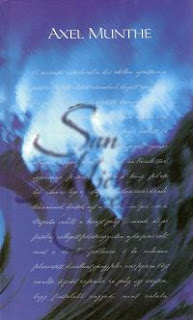
I received this book on last Christmas from my girlfriend, it gives a delectable experience, an interesting and engaging reading. The title of the book holds the name of San Michele Villa from the marvelous Italian Capri island, a villa which was build by the Swedish doctor Axel Munthe as his home. In the book Axel Munthe tells his own life story ,a remembrance of a life spent as a doctor of poor, of high society and that of an animal lover. We find him in Paris as a former assistant of Charcot at Salpetriere and as a popular and successful doctor with rich clientele, in his native Sweden in Lapland, in Naples in the time of cholera fighting the epidemic, in his beloved Anacapri of Capri island where he builds his villa from ancient ruins in the garden of Cesar Tiberius and were he writes his memories. In his garden found refuge his pets: his dogs and Billy the nasty monkey. His villa still remains on of the attractions of Anacapri. The cover is of the Hungarian edition titled San Michele regénye. The Story of San Michele at Amazon. If you are keen you can read online the The story of San Michele at Internet Archive.org. Other online books by Axel Munthe are available at Open Library.

Subscribe to:
Posts (Atom)


